


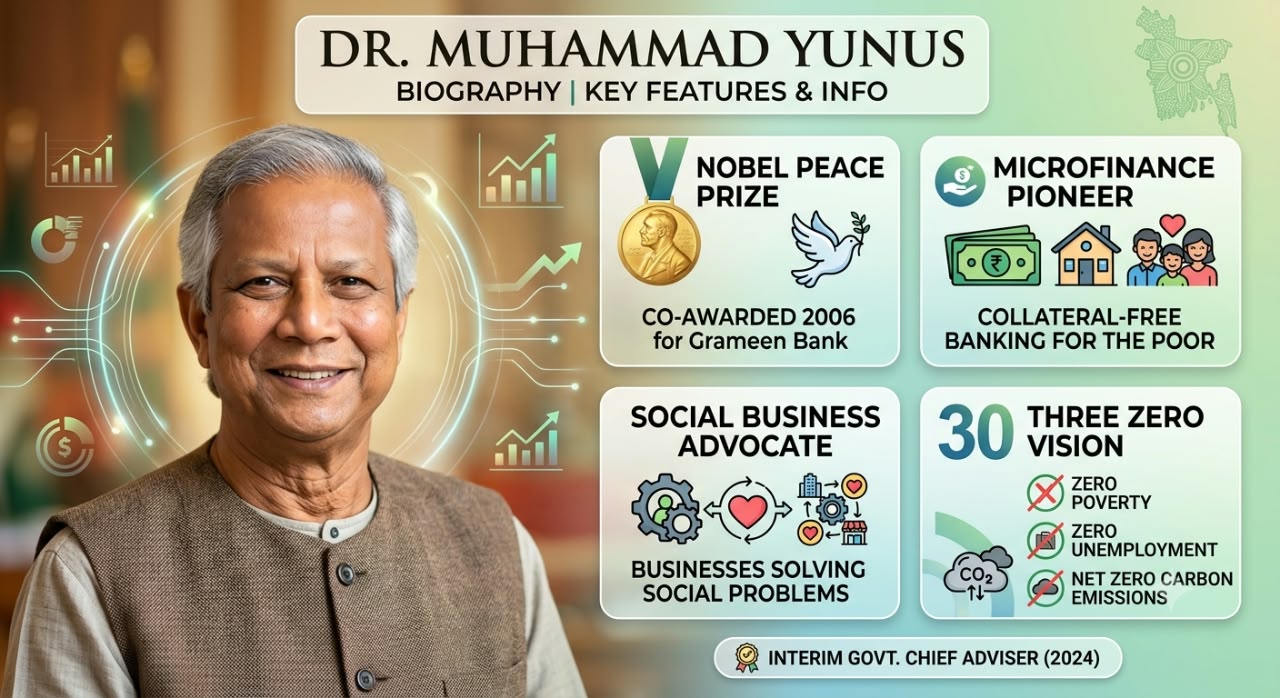
Dr. Muhammad Yunus Biography: Nobel Laureate to Interim Govt Chief
Dr. Muhammad Yunus (born June 28, 1940) is a Bangladeshi economist, entrepreneur, Nobel Peace Prize laureate, and the Chief Adviser of the Interim Government of Bangladesh. Globally renowned as the pioneer of microfinance and social business, he revolutionized poverty alleviation by introducing collateral-free banking for the poor through the Grameen Bank. Following the student-led mass uprising in August 2024, he assumed leadership of Bangladesh’s interim government to guide state reforms and democratic restructuring.
Early Life and Education
- Birth & Family: Born in the village of Bathua in Hathazari, Chittagong, Dr. Muhammad Yunus was the third of nine children born to Hazi Dula Mia Hazi, a jeweler, and Sufia Khatun.
- Early Schooling: He attended Chittagong Collegiate School, where he ranked among the top students in East Pakistan, and later studied at Chittagong College.
- Higher Education: He earned his Bachelor’s (1960) and Master’s (1961) degrees in Economics from the University of Dhaka.
- Doctoral Studies: In 1965, he received a Fulbright Scholarship to study in the United States and obtained his Ph.D. in Economics from Vanderbilt University in 1969.
Academic Career and the Genesis of Microcredit
- Early Academic Roles: After completing his Ph.D., Dr. Muhammad Yunus served as an Assistant Professor of Economics at Middle Tennessee State University. He returned to Bangladesh in 1972 shortly after its independence and joined the University of Chittagong as the Head of the Economics Department.
- The Jobra Experiment (1976): During the devastating famine of 1974, Dr. Muhammad Yunus observed that traditional banking systems refused to lend to the poor, leaving local villagers dependent on predatory moneylenders. In 1976, he lent $\$27$ of his own money to a group of 42 women in the nearby village of Jobra, enabling them to purchase materials for bamboo furniture without exorbitant interest rates.
- Establishment of Grameen Bank (1983): Proving that poor people—especially women—were creditworthy borrowers with high repayment rates, he formalised this model into a specialized financial institution. Grameen Bank (“Village Bank”) was established by national law in 1983. Its community-based “trust group” model has since been replicated in over 100 countries worldwide.
Social Business & The “Three Zeros” Framework
- Social Business Model: Dr. Yunus introduced the concept of “Social Business”—a non-dividend, self-sustaining enterprise designed solely to address social or environmental problems rather than maximize shareholder profit. He co-founded several high-impact ventures under this framework, including Grameen Danone (combating malnutrition) and Grameen Veolia (providing clean drinking water).
- The Three Zero Vision: He advocates for a global economic paradigm based on three core targets:
- Zero Poverty (by unlocking individual entrepreneurship).
- Zero Unemployment (by transforming job seekers into job creators).
- Zero Net Carbon Emissions (by creating sustainable economic ecosystems).
Political Engagement & Interim Government Leadership (2024–Present)
- Political Initiative (2007): During the 2007–2008 caretaker government period, Dr. Yunus briefly announced plans to form a political party named Nagorik Shakti (Citizens’ Power), though he withdrew the initiative shortly after to focus on social work.
- Legal and Political Pressure: Under the subsequent administration, Dr. Yunus faced various legal challenges and tax investigations, which were widely viewed by international bodies and human rights organizations as politically motivated.
- Chief Adviser of the Interim Government (August 2024–Present): Following the fall of the previous regime amid student-led anti-discrimination protests in August 2024, student organizers and political stakeholders unanimously requested Dr. Muhammad Yunus to lead the nation. On August 8, 2024, he was sworn in as the Chief Adviser of the Interim Government of Bangladesh, tasked with restoring macroeconomic stability, rebuilding democratic institutions, executing constitutional reforms, and preparing for free national elections.
Major International Honors and Recognition

| Award / Recognition | Awarding Body / Country | Year | Key Significance |
| Ramon Magsaysay Award | Ramon Magsaysay Award Foundation, Philippines | 1984 | Recognized for community leadership |
| Independence Day Award | Government of Bangladesh | 1987 | Highest civilian honor in Bangladesh |
| Nobel Peace Prize | Norwegian Nobel Committee | 2006 | Awarded jointly with Grameen Bank for microfinance work |
| Presidential Medal of Freedom | United States Government | 2009 | Highest civilian honor in the United States |
| Congressional Gold Medal | United States Congress | 2013 | Highest award granted by the US Legislative Branch |
| Olympic Laurel | International Olympic Committee (IOC) | 2020 | Recognized for leveraging sports for social development |
(Dr. Yunus is one of only seven individuals in history to receive the Nobel Peace Prize, the US Presidential Medal of Freedom, and the US Congressional Gold Medal.)
FAQ
Q1: Who is Dr. Muhammad Yunus, and why is he famous?
A: Dr. Muhammad Yunus is a world-renowned economist, Nobel Peace Prize laureate, and the Chief Adviser of the Interim Government of Bangladesh. He is globally recognized for pioneering microcredit and social business, as well as founding Grameen Bank to empower impoverished communities.
Q2: When did he win the Nobel Peace Prize and why?
A: In 2006, Dr. Muhammad Yunus and Grameen Bank were jointly awarded the Nobel Peace Prize for their revolutionary work in creating economic and social development from the bottom up through microfinance.
Q3: What is the “Three Zeros” concept?
A: The “Three Zeros” is a global economic framework proposed by Dr. Yunus aiming for:
1. Zero Poverty (by empowering individuals as entrepreneurs)
2. Zero Unemployment (by transforming job seekers into job creators)
3. Zero Net Carbon Emissions (by building sustainable economic systems)
Q4: What top international honors has he received?
A: He is one of only seven individuals in history to receive the Nobel Peace Prize, the US Presidential Medal of Freedom (2009), and the US Congressional Gold Medal (2013).
Dr. Yunus’s vision for microfinance truly highlights the power of community support in transforming lives. It’s inspiring to see how his ideas have reached so many around the globe. ColoringLoft
Dr. Yunus’s approach to empowering the poor through microfinance is a testament to his belief in social entrepreneurship. I was particularly struck by how he emphasizes the importance of trust and direct engagement with communities, which sets his model apart from traditional lending practices. It truly illustrates the profound impact that innovative thinking can have on societal issues. StubMath