Earthquake English Paragraph-100, 150, 200, 250, 300 & 400 Words
Earthquake English Paragraph For Class 6, 7, 8, 9-10, 11-12, Job Holder, IELTS, TOEFL
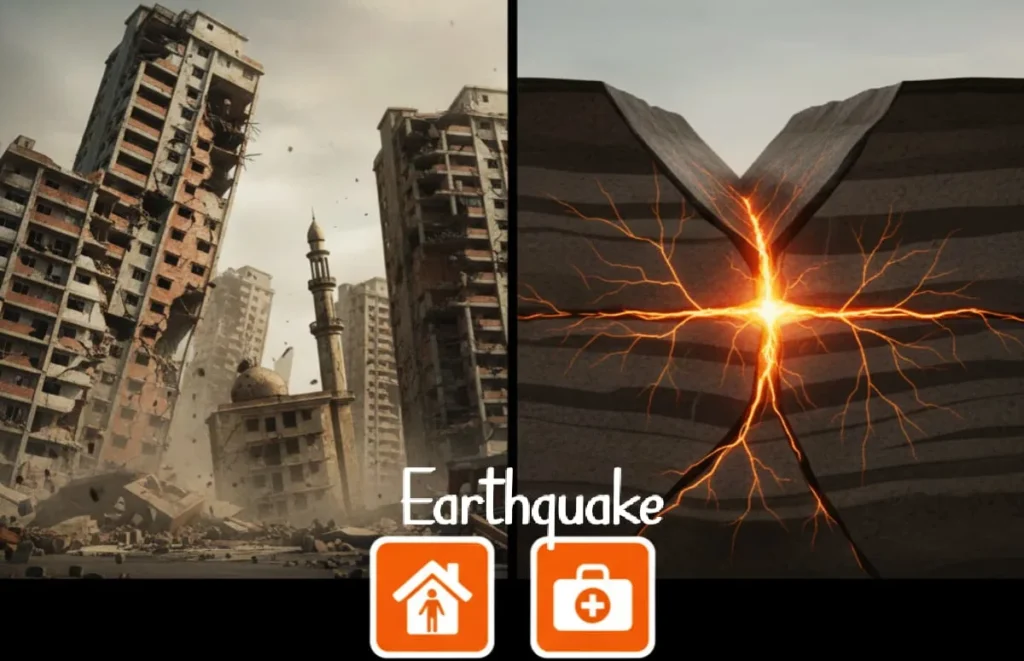
Paragraph – 100 Words
Earthquake is a terrible natural disaster. Earthquakes are caused by the sudden movement of the rock layers inside the earth. As a result, the surface of the earth shakes violently. Due to earthquakes, buildings collapse, roads are damaged and countless people lose their lives. The collision of tectonic plates is the main cause of earthquakes.
Bangladesh is also located in an earthquake-prone area. During an earthquake, one should take shelter under a solid structure. It is safe to quickly move to an open field. Earthquakes cannot be prevented, but damage can be reduced through awareness and preparation.
Mini-summary: This paragraph highlights the definition, causes, effects and brief safety measures of earthquakes, which are suitable for students of younger classes.
Earthquake Paragraph – 150 Words
Earthquake is one of the most dangerous natural disasters in the world. Earthquakes happen when tectonic plates inside the Earth move suddenly or rub against each other. This releases a huge amount of energy, causing the Earth’s surface to shake. Earthquakes can last from just a few seconds to a few minutes. However, their effects are very destructive. Large buildings collapse, roads crack, and electricity and gas lines get cut off. Thousands of people lose their lives or get injured.
Many countries in the world, including Japan, Nepal, Turkey, and China, are located in earthquake-prone areas. There is also a risk of earthquakes in Bangladesh. During an earthquake, one should not panic and quickly take shelter in a safe place. It is possible to reduce the damage caused by earthquakes with the joint efforts of the government and the people.
Mini-summary: This paragraph is suitable for secondary level, including the causes, stability, effects, and examples of countries at risk of earthquakes.
Earthquake Paragraph – 200 Words
Earthquake is a natural disaster that is caused by sudden tremors in the earth’s crust. The tectonic plates located inside the earth are constantly moving. Collisions, friction, and one plate sliding beneath another build up a huge amount of energy inside the Earth. When the ground suddenly releases this stored energy, the movement creates an earthquake..
Earthquakes usually last from a few seconds to a minute. However, strong earthquakes can last for several minutes.
Earthquakes cause extensive damage.Earthquakes make multi-storey buildings collapse and tear apart roads and bridges. They also cut electricity, water, and gas lines. As a result, countless people lose their lives and millions end up homeless.The 2015 Nepal earthquake and the 2023 Turkey-Syria earthquake are vivid examples of this. Bangladesh is also located in an earthquake-prone area.
Dhaka city is particularly at risk. During an earthquake, one should take shelter under a table or sturdy furniture. It is safer to go out by stairs instead of using the elevator. If possible, one should quickly move to an open field. Even though we cannot prevent earthquakes, we can save lives and protect property through awareness and careful preparation.
Mini-summary: This article discusses in detail the scientific explanation of earthquakes, their effects, practical examples, and risks in Bangladesh.
Earthquake Paragraph – 250 Words
Earthquake is a natural disaster that manifests itself through sudden shaking of the earth’s surface. The earth’s crust is made up of several large tectonic plates. These plates are constantly moving while floating on liquid magma in the interior of the earth.When two plates collide, slide under each other, or move side by side, they build up a huge amount of energy. When the ground suddenly releases this energy, it creates an earthquake. Scientists call the starting point of the quake the focus, and the point on the Earth’s surface directly above it the epicenter.
Earthquakes are measured on the Richter scale. This scale determines the intensity of an earthquake from 1 to 10. Earthquakes below magnitude 5 are usually not very harmful. But earthquakes above magnitude 7 can be very destructive. Earthquakes cause buildings to collapse, roads to burst, bridges to collapse and landslides. Earthquakes in coastal areas can cause tsunamis, which are even more destructive. The 2004 Indian Ocean tsunami and the 2011 Japan tsunami are vivid proof of this.
Bangladesh is located in an earthquake-prone area. The risk of earthquakes is higher in the northeastern and southeastern parts of the country. Due to unplanned infrastructure and dense population in Dhaka city, earthquake damage can be even greater. It is important to remain calm and not panic during an earthquake. Take shelter under a sturdy table or door frame. After the earthquake stops, one should go outside with caution. We cannot prevent earthquakes, but we can reduce damage by raising awareness, providing training, and building earthquake-resistant structures.
Mini-summary: This article discusses the scientific causes of earthquakes, the Richter scale, the relationship between tsunamis, the risks of Bangladesh and detailed safety measures.
Earthquake Composition- 300 Words
Earthquake is one of the oldest and most terrible natural disasters in the world. Since ancient times, people have witnessed the horrors of earthquakes. Earthquakes are sudden, powerful vibrations of the Earth’s surface caused by the movement of tectonic plates beneath it. The Earth’s crust consists of seven large and many smaller tectonic plates. These plates float on the earth’s mantle and move a few centimeters a year.
There are three types of boundaries between tectonic plates. At convergent boundaries, two plates move towards each other and collide. At divergent boundaries, two plates move away from each other. And at transform boundaries, two plates move side by side. Earthquakes can occur at all three types of boundaries. When the pressure or friction between the plates increases excessively, a sudden release of energy occurs and an earthquake occurs. The point where an earthquake starts is called the focus or hypocenter, and the point directly above it on the surface is called the epicenter.
Scientists use seismographs to record earthquakes, and they determine their intensity using the Richter scale and the moment magnitude scale Thousands of earthquakes occur in the world every year. However, very few of these earthquakes are felt by people. Earthquakes of less than magnitude 5 usually do not cause much damage. But earthquakes of more than magnitude 7 cause widespread destruction.
The effects of earthquakes are very widespread and long-lasting. Buildings collapse, roads and bridges break, electricity and communication systems are disconnected. Sometimes landslides and soil liquefaction occur. Earthquakes in coastal areas can cause tsunamis that flood large areas. Millions of people have lost their lives due to earthquakes in different countries of the world. The 1935 Quetta earthquake, the 2010 Haiti earthquake, and the recent Turkey-Syria earthquake are evidence of its horror.
Bangladesh is located in an earthquake-prone area. The Dawki Fault is in the northeast of the country and the Chittagong Fault is in the southeast. In addition, Bangladesh is prone to earthquakes because it is located near the junction of the Indian, Eurasian and Burmese tectonic plates. Due to unplanned building construction, dense population and narrow roads in Dhaka city, earthquake damage can be very high. Experts believe that a large earthquake can cause massive loss of life and property in Dhaka. Therefore, it is important to prepare now.
Taking the right steps during an earthquake can reduce the loss of life. During an earthquake, one should not panic and follow the drop, cover and hold on method. That is, sit on the ground, take shelter under hard furniture and hold on tightly. One should stay away from windows and glass. After the earthquake stops, one should go out carefully. One should not use the elevator and go down the stairs. With the joint efforts of government agencies and conscious citizens, it is possible to reduce the damage caused by earthquakes by building earthquake-resistant buildings, increasing public awareness and developing a quick rescue system.
Mini-summary: This section is suitable for upper secondary level with a complete scientific explanation of earthquakes, plate tectonics, measurement methods, global and Bangladeshi context, and detailed safety measures.
Earthquake Eassy- 400 Words
Earthquake is one of the most terrible and unpredictable natural disasters in the world. Thousands of earthquakes occur in different parts of the world every year. However, only a few large earthquakes have a huge impact on human life. An earthquake happens when the Earth’s surface shakes suddenly and violently due to internal geological processes. This natural phenomenon is mainly related to the movement, collision and breakdown of rock layers of the tectonic plates.
The earth’s crust is mainly made up of several large and small tectonic plates called the lithosphere. These plates move very slowly while floating on the semi-fluid layer of the earth called the asthenosphere. Each year, these plates move only a few centimeters. However, this slow movement stores a huge amount of energy over a long period of time. Three types of interactions occur at the boundaries of tectonic plates. At a convergent boundary, two plates move toward each other, collide, and one plate sinks beneath the other — a process called subduction — while at a divergent boundary, the plates move apart and new crust forms, and at a transform boundary, the plates slide side by side in opposite directions. Earthquakes can occur at all three types of boundaries.
When the friction, pressure, or tension between tectonic plates increases excessively, the rock layer can no longer withstand the pressure and suddenly breaks. The stored energy as a result of this breakage spreads in all directions in the form of waves. Scientists call this movement a seismic wave. The origin or focus of an earthquake is inside the Earth. And the point just above it on the surface is called the epicenter. The effect of the earthquake is greatest at the epicenter, and its intensity decreases with increasing distance.
Scientists use a special instrument called a seismograph to measure earthquakes.. This instrument records the seismic waves and creates a seismogram.
Scientists use the Richter scale and the moment magnitude scale to measure how strong an earthquake is. The Richter scale has a scale from 1 to 10.Humans usually don’t feel earthquakes below magnitude 3, earthquakes above magnitude 5 can cause moderate damage, and those above magnitude 7 can be extremely destructive.The most powerful earthquake in history was the 1960 Chilean earthquake, which had a magnitude of 9.5.
The effects of earthquakes are extensive and multifaceted. First, there is damage to buildings and infrastructure. High-rise buildings, bridges, roads, power lines, and water pipes can collapse or get damaged. Many people can lose their lives, with thousands trapped under the rubble of fallen buildings. Earthquakes also cause significant economic damage.
Property damage, job losses and reconstruction costs have a serious impact on the economy. Fourth, there are environmental impacts. Landslides, soil liquefaction and earthquake-induced fires damage the environment. Fifth, earthquakes in coastal areas can cause tsunamis. When an earthquake occurs under the sea, it creates huge waves that hit the coast and cause widespread destruction. The 2004 Indian Ocean tsunami killed about 250,000 people.
Countries around the world are located in earthquake-prone areas. 90 percent of the world’s earthquakes occur in the area known as the Pacific Ring of Fire. This area includes Japan, Indonesia, the Philippines, Chile, Peru and the west coast of the United States. In addition, countries around the Himalayan Mountains are also at risk of earthquakes. Nepal, India, Pakistan, Afghanistan, China and Bangladesh are located in this region.
Bangladesh is a geologically earthquake-prone country. Bangladesh is located near the junction of three major tectonic plates – the Indian plate, the Eurasian plate and the Burmese microplate. The country lies near the Dawki fault in the northeast, the Tripura fault in the east, and the Chittagong fault in the southeast. These faults are active and can be the source of earthquakes at any time. According to historical records, a magnitude 7.0 earthquake occurred in Bangladesh in 1885. In recent years, people in Bangladesh have felt small and medium-sized earthquakes, showing that major earthquakes could happen in the future.
Dhaka city is particularly vulnerable to earthquakes. More than 20 million people live in Dhaka. The city is prone to earthquake damage due to unplanned and faulty construction of buildings, non-compliance with building codes, narrow roads and overpopulation. Experts have warned that an earthquake of magnitude greater than 7 could kill millions of people in Dhaka and destroy property worth crores of taka. Therefore, urgent preparations are needed.
Taking the right steps during an earthquake can save many lives. When an earthquake starts, you should stay calm and not panic. If you are indoors, you should take shelter under a sturdy table or desk. You can also stand under a doorway. You should stay away from windows, mirrors, shelves, and heavy furniture. If you are outdoors, you should move to an open area and stay away from buildings, trees, and power lines. If you are in a car, you should park your car in a safe place and stay inside. After the earthquake stops, you should carefully exit. Do not use the elevator and take the stairs. You should not enter damaged buildings. If gas might leak or an electrical short circuit occurs, turn off the main switch immediately.
Earthquake preparation is very important. Everyone in the family should learn about earthquakes, and the family should practice drills regularly. Prepare emergency supplies like food, water, medicine, flashlights, and a first aid kit. When constructing buildings, follow earthquake-resistant designs and construction methods to stay safe. The government should strictly implement building codes, identify old and risky buildings, and strengthen rapid rescue and relief measures. Media and educational institutions should raise public awareness.
Earthquakes are a natural phenomenon that cannot be prevented. However, through awareness, preparation, scientific research and the use of modern technology, it is possible to significantly reduce the damage caused by earthquakes. In countries like Japan, where earthquakes occur regularly, the damage is much less due to proper preparation.In Bangladesh, careful preparation can protect you from the dangers of earthquakes.
Mini-summary: This detailed article covers the complete scientific basis of earthquakes, tectonic theory, measurement methods, global and local effects, geological location of Bangladesh, risks in Dhaka, detailed safety measures and preparation guidelines. Suitable for higher secondary and competitive exams. For earthquake data and scientific information
FAQ
Earthquakes happen mainly because tectonic plates move. The Earth’s crust consists of several large plates that are constantly shifting. As these plates collide, rub against each other, or slide beneath one another, they store a huge amount of energy. When this energy releases suddenly, it causes an earthquake.
Scientists use seismographs to record earthquakes. They determine an earthquake’s intensity with the Richter scale and the moment magnitude scale. The Richter scale ranges from 1 to 10, and earthquakes above magnitude 7 are considered very destructive.
Bangladesh lies in an earthquake-prone area because it sits near the junction of three tectonic plates. The Dawki Fault, Tripura Fault, and Chittagong Fault increase the risk. Dhaka, in particular, faces high risk due to unplanned construction and a dense population.
During an earthquake, stay calm and don’t panic. If you’re indoors, take shelter under a sturdy table or desk. If you’re outdoors, move to an open field and stay away from buildings and trees. After the shaking stops, use the stairs instead of the elevator.
Currently, scientists cannot predict earthquakes accurately. However, they can identify areas prone to earthquakes through research. Seismic zone mapping and geological studies help determine regions at potential risk.
A tsunami happens when an earthquake on the ocean floor displaces a large amount of water, creating massive waves. When an undersea earthquake occurs, it displaces a large amount of water and generates high-speed waves. These waves hit the coast and cause massive destruction. The 2004 Indian Ocean tsunami is a well-known example.
Engineers design and build earthquake-resistant buildings to withstand strong shaking. They use flexible foundations, reinforced structures, shear walls, and special building materials. Countries like Japan, Chile, and the United States require such construction for safety.
