The Chinese Dream: Short & Long Version Essay/Composition
The Chinese Dream Essay/Composition For Classes 6, 7, 8, 9-10, 11-12 & All Exams
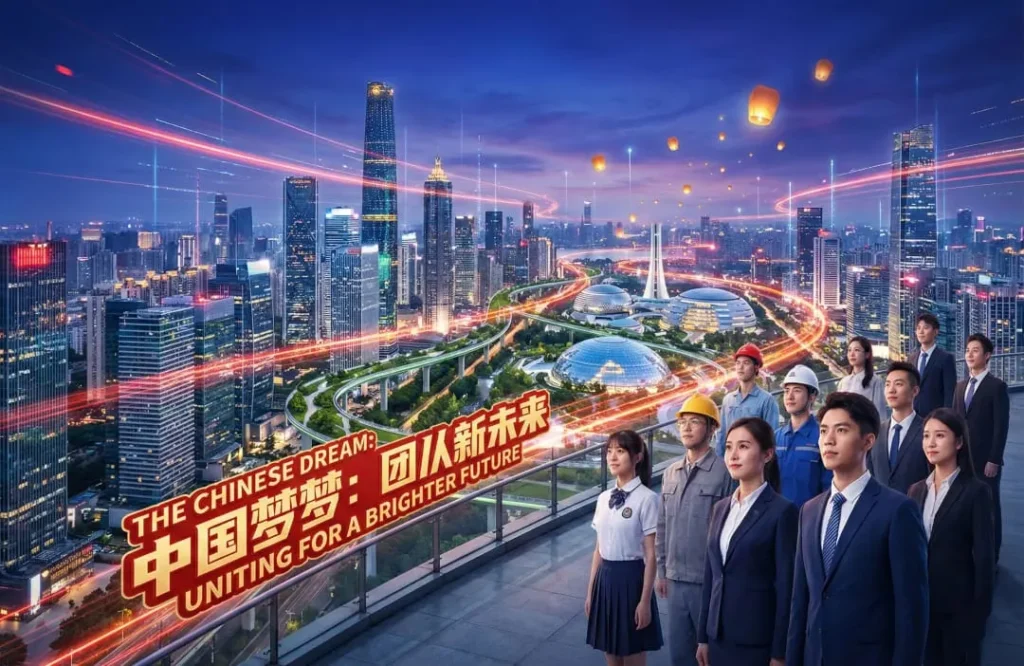
Chinese Dream Essay (Short—200 words)
Introduction
The Chinese Dream is a political ideology of China’s national rejuvenation. This concept was first put forward by Chinese President Xi Jinping in 2012. The main goal of this dream is to build China into a prosperous, strong, and modern country. The Chinese Dream not only focuses on economic development; however, it also highlights social equality, environmental protection, and the preservation of cultural heritage.
The main elements of the Chinese Dream
This dream has three main goals. First, to increase the country’s overall strength. Second, to improve the people’s living standards. Third, to establish China’s status on the world stage. China is investing heavily in technology, education, healthcare, and infrastructure development.
Implementation
This dream is actively implemented through initiatives such as the Belt and Road Initiative, Made in China 2025, and the Digital China project. Furthermore, China has also achieved remarkable progress in poverty alleviation.
Conclusion
The Chinese Dream is a long-term plan that aims to make China a world power by 2049. This is an important vision not only for China but also for global development.
Chinese Dream Essay (Detailed – 800+ words)
Introduction: What is the Chinese Dream?
The Chinese Dream is a comprehensive vision of China’s national rejuvenation. In November 2012, Xi Jinping, General Secretary of the Communist Party of China and President, formally put forward the concept. It is a concept similar to the American Dream, but its purpose is different. The Chinese Dream emphasizes national prosperity and social harmony in addition to individual achievement. The core of this dream is to transform China into a moderately prosperous society and establish it as a modern socialist country by 2049. China’s long history, cultural heritage, and current economic strength are the foundations of this dream.
Mini-Summary: The Chinese Dream is the goal of China’s national rejuvenation that Xi Jinping announced in 2012.
Historical Background of the Chinese Dream
After the Opium Wars in the 19th century, China was defeated by Western powers. The country was then weak for a long time. In 1949, Mao Zedong founded the People’s Republic of China. However, China’s real rise began after Deng Xiaoping’s reform and open-door policy in 1978. In the past four decades, China has become the second-largest economy in the world. The Chinese Dream is the next stage of this rise. It expresses China’s desire to overcome the “century of humiliation” and regain global leadership. This long journey through history has made the Chinese Dream even more significant.
Mini-Summary: China’s rise from historical humiliation and Deng Xiaoping’s reforms have laid the foundation for the Chinese Dream.
The main pillars of the Chinese Dream
The Chinese Dream has three main goals:
1. Achieving national prosperity
China wants to become a powerful state in economic, military, and technological terms. The country is working to become a world leader in 5G technology, artificial intelligence, space exploration, and green energy. China’s annual GDP growth is still quite high. The country plays an important role in global trade.
2. Ensuring people’s happiness
Improving the living standards of every Chinese citizen is one of the key goals of this dream. In this regard, China has made remarkable progress in eradicating poverty. By 2020, the country had completely eliminated extreme poverty. At the same time, education, healthcare, housing, and social security systems are steadily improving. As a result, the middle class is growing rapidly.
3. Completing national rejuvenation
China wants to regain its traditional glory. The country is eager to play a more active role in global governance. China’s influence is growing in the United Nations, the World Trade Organization, and other international platforms. China is also paying attention to cultural exchanges and increasing soft power.
Mini-Summary: The main pillars of the Chinese Dream are economic prosperity, people’s happiness, and national rejuvenation.
Strategies to Realise the Chinese Dream
China has adopted several strategic plans to realize its dream:
Belt and Road Initiative (BRI)
This is the world’s largest infrastructure project. Roads, railways, ports, and pipelines are being built across Asia, Europe and Africa. Through this, China is creating a global trade network. More than a hundred countries are participating in this project.
Made in China 2025
This plan aims to turn China into an advanced manufacturing power. To achieve this, China seeks to become a world leader in robotics, aviation, renewable energy, and biotechnology. At the same time, strong emphasis is being placed on domestic innovation and brand building.
Digital China
China is a world leader in e-commerce, digital payments, smart cities, and the Internet of Things (IoT). Tech giants such as Alibaba, Tencent, Huawei, and Baidu are accelerating China’s digital transformation.
Green Development
China is the world’s largest investor in renewable energy. The country is a leader in solar and wind power generation. It plans to reach carbon neutrality by 2060.
Mini-Summary: BRI, advanced manufacturing, digitalization, and green development are the core strategies of the Chinese Dream.
Challenges and Criticism
There are some challenges to realizing the Chinese Dream. Global trade tensions, especially with the United States, are a major obstacle. Population growth is slowing, and aging is emerging. Environmental pollution is still a serious problem. Social inequality has not been eliminated. Some countries criticize China’s Belt and Road Initiative as “debt trap diplomacy.” There is Western criticism over human rights and the issues of Tibet, Hong Kong, and Xinjiang. However, China is working to address these challenges.
Mini-Summary: Trade tensions, population problems, environmental pollution, and international criticism are challenges to the Chinese Dream.
Chinese Dream vs. American Dream
The American Dream emphasizes individual freedom and personal success. On the other hand, the Chinese Dream speaks of collective prosperity and national rejuvenation. The American Dream is dominated by a free market economy. State control is important in the Chinese Dream. However, both dreams are committed to improving people’s living standards. China has developed its own model that is different from the Western model but effective.
Mini-Summary: The Chinese Dream believes in collective goals, while the American Dream emphasizes individual freedom.
Education for Bangladesh
Bangladesh can learn a lot from the Chinese Dream. Long-term planning and continuity are essential for development. Investment in technology and innovation must be increased. China’s model is worth following in poverty alleviation. Infrastructure development is the foundation of economic growth. Education and skill development must be emphasized. However, every country has its own context. Bangladesh needs to develop its own model.
Mini-Summary: Bangladesh can learn from the Chinese Dream about long-term planning, technology investment, and poverty alleviation.
Conclusion
The Chinese Dream is not just a political slogan but a comprehensive outline of China’s overall development. It has united the Chinese people around a common goal. China has made tremendous progress in the past decade. The country is now one of the most influential powers in the world. If the Chinese Dream is realized, it will affect not only China but the entire world. But this journey is not easy. There are many challenges and obstacles. China’s success will depend on how it meets these challenges. The Chinese Dream presents a new model of development concept in the modern world that is worthy of study and understanding.
Read Chinese Culture And Tradition
FAQ
The Chinese Dream was officially announced by Xi Jinping in November 2012. He put forward the idea after he became the General Secretary of the Communist Party of China.
The main goal, therefore, is to turn China into a prosperous, strong, and modern socialist country by 2049. In doing so, it emphasizes sustained economic development, along with social equality and ultimately national rejuvenation.
It is a global infrastructure development project of China. Through it, trade and connectivity are being increased with countries in Asia, Europe, and Africa. More than a hundred countries are participating in it.
The American Dream emphasizes individual success and independence. The Chinese Dream believes in collective prosperity and achieving national goals. State control is a feature of the Chinese Dream.
China has achieved significant success in many areas. China is leading in poverty alleviation, economic growth, and technological development. However, there are also challenges such as trade tensions and environmental problems.
Bangladesh can learn from China’s development strategy. China’s model in long-term planning, technology investment, and infrastructure development is worth following. China is an important trade and development partner of Bangladesh.
Some countries criticize China’s BRI project as “debt trap diplomacy.” Western countries express concerns over human rights and Tibet, Hong Kong, and Xinjiang issues. Environmental pollution and social inequality are also issues of criticism.
